
Built for breweries and distilleries supplying pubs and venues.
Give your customers a clearer way to place day-to-day orders while your team keeps products, packaging, sites, and order progress in one shared workflow.
Already using CraftyOrder? Log in here.
Built for suppliers running repeat trade
CraftyOrder is built for supplier-to-customer ordering where products, packaging, sites, and order progress need to stay clearer than they do in email threads and ad hoc messages.
It is especially suited to breweries and distilleries supplying pubs, bars, and hospitality groups.
For Breweries/Distilleries: Suppliers
Supplier- • Keep day-to-day orders clearer across customers, venues, and delivery Sites
- • Give customers one structured way to order instead of relying on inboxes, handwritten notes, and memory
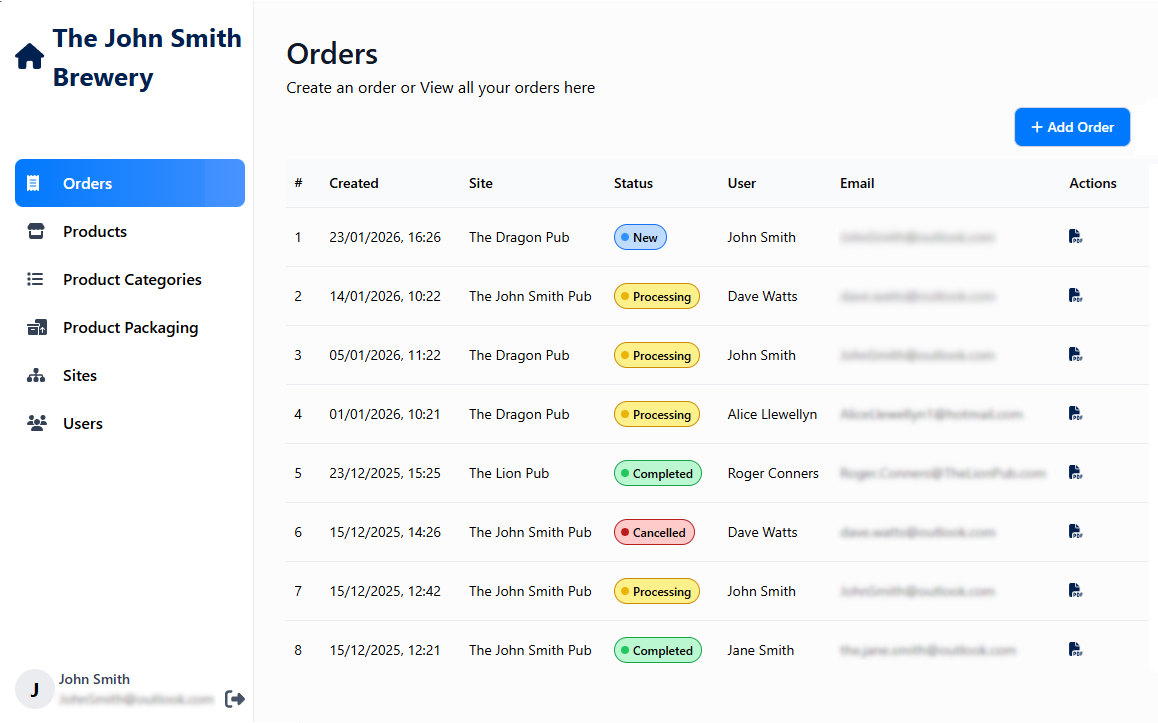
- • Review order progress in one place without chasing updates across messages
- • Reduce avoidable confusion around products, packaging, and who ordered what
For Pubs/Venues: Customers
Customer- • Place day-to-day orders in a clearer, more consistent way
- • Order against the right site so deliveries go to the correct location
- • Choose from structured product and packaging options instead of free-text requests
- • Check order status without having to call or email for updates
- • Make ordering easier for teams, not just for one person who knows the process
What changes with CraftyOrder
The value is operational: clearer day-to-day ordering, less back-and-forth, and a workflow that is easier for both suppliers and customers to follow day to day.
Streamlined order flow
Site-based ordering
Clearer products and packaging
Shared visibility for teams
Streamlined order flow
Keep day-to-day ordering easier to follow from request through to completion.
Everyone can see the same order progress in one place.
How it works
CraftyOrder gives suppliers and their customers a short, clear workflow for day-to-day ordering as the product exists today.
1) Set up your catalogue and customer sites
Set up your catalogue in the right order by defining categories and packaging where needed, then add the products and customer sites you want customers to order against.
2) Customers place structured orders
Customers order against the right location using clear product and packaging choices instead of relying on free-text requests, emails, or message threads.
3) Track progress in one shared workflow
Once an order is submitted, everyone can follow status in one place without separate update chasing or relying on one person to relay what happens next.
FAQ
Short answers to the main fit, trust, and rollout questions.
Ready to make ordering easier for your team and customers?
If day-to-day ordering still depends too much on emails, messages, spreadsheets, or one person remembering how it all works, this is the point to move it into one clearer workflow.
Already a customer?Log in